
As those of you who’ve checked out my other posts may know, I am a massive manga fan. I got into it during the pandemic after reading some suggestions I had gotten from some of my friends, and at the time I am writing this, I have completed 115 total series of varying lengths and varieties, with the vast majority of those being from this year after I decided to make it a goal to reach 100 total manga and 20 total theology books completed by the end of the year. I started the year with around 46 manga completed and four theology books completed respectively, and I figured it would be a better use of my time instead of constantly playing video games. If I had it my way, those two numbers would’ve been flipped, but theology books are more challenging to come by online and are often quite expensive, making it more difficult to read them. Thankfully, it hasn’t stopped me, as I’m on number 14 out of 20 right now.
All that aside, a few months ago, I wanted to read something more on the suspenseful side. I’ve always loved a good murder mystery or psychological thriller, and so I scoured the web to find manga that fit that category, which I did. Just before starting one of them, I got a message from a good friend suggesting that I read this Korean series called Bastard. She sold it as something that I would like and something that would get under my skin. Naturally, I was interested. I looked it up and read about the plot, what content was featured within, and how many chapters there were. After doing all of that, I decided then and there that it was time to take the plunge into manhwa, and I haven’t looked back since.
Now, this was the first time I had read a manhwa, which was partially due to some preconceived notions that I had about the medium. One of the main criticisms thrown at manhwa is that too many feature the same plot ideas with little to no difference when comparing series and that there is a lack of originality. After doing some research, I feel that this is a somewhat valid opinion. There are so many stories about antisocial guys finding themselves in their favorite video games or web novels or girls reincarnating into princesses in a fantasy world, and while some of these stories are done quite well and subvert these tropes, many are just generic and don’t serve much purpose. Another reason I was hesitant was because of how many boys’ love stories and girls’ love stories there are and just how popular many of them are. Quite frankly, neither of those types of stories produced any good feelings within my soul for very obvious reasons, and I made the generalization that most manhwa were full of things like that and that they should be avoided in general.

I’ll say it now: I was wrong about that. Entirely wrong. Remember Bastard, the story that my friend recommended to me? I read the entire thing in a day, all 94 chapters of it. As it stands, it is still in my top 10 series of all time, and it is a story that I recommend to anyone who likes a good scare or the feeling of being on the edge of your seat. It’s an excellent story about finding purpose, connecting with people, and standing up to the evil you see in life. In this case, it’s the main character, a teenage student, standing up to his rich serial killer of a dad and trying to protect a fellow student of his from being his dad’s next victim. Spoiler alert: he is successful, but instead of saying how that happens, I encourage you to read the story yourself. There are some pretty crazy twists that I don’t want to spoil.
After Bastard, I was hooked. I updated my goal of completing 100 manga and added that manhwa would count towards that goal because there is a decent amount of overlap between the two genres. My next series was Sweet Home, which is by the same author as Bastard and has a pretty successful live-action adaptation. While I didn’t enjoy it as much as Bastard, it was still a fun read and a unique take on the zombie apocalypse trope. Afterward, the same friend who recommended Bastard also recommended Omniscient Reader’s Viewpoint (ORV for short), a currently ongoing series that sounded similar to the “antisocial guy finds himself in his favorite video game or web novel” trope I outlined earlier. While it fits the latter in many ways, it also takes that trope and completely turns it on its head with a crazy meta plot and some insane plot twists and worldbuilding. If I had to recommend a random manhwa to someone wanting to get into manhwa, ORV would be one of two main recommendations that I have. It’s easily one of my favorite ongoing reads and has one of the more badass protagonists you’ll come across.
Meanwhile, the other one I would recommend to first-timers is a story that I often find hard to describe. There is a good reason for this, trust me. When my friend, who recommended Bastard and ORV, said that I should read The Boxer, she prefaced it by saying that it was easily her favorite manhwa and that it was written by a Christian. That startled me! A Christian man writing a manhwa? That was quite surprising until I took a step back and remembered that Christianity is quite big in Korea and that several believers have very sound theology there. Upon hearing that, I set everything else that I was reading aside, found a good time to start it, and did so with gusto.

Before I go any further, I want to give a shoutout to my friend who recommended all these series. She’s a real one when it comes to her faith and her tastes in games, food, and especially manga/manhwa. Without her explaining what manhwa can really be like sometimes, I’m sure I wouldn’t have taken the chance that I did on series like Bastard, ORV, Seasons of Blossom (another masterpiece that I highly recommend), and so on. I also wouldn’t have given The Boxer a chance, despite my affinity for boxing stories like the Rocky movies and Raging Bull.
Anyway, about The Boxer. It is amazing. It’s just amazing. Like I said before, I often find it hard to describe this series. Not because the plot is overly complicated or because the themes are jumbled, but because the core message hidden within is so important and powerful that I almost get emotional whenever I talk about it. What is that message? Simply put, The Boxer is an allegory of the journey many take before finding solace in Jesus Christ. It is the story of a troubled young man who finds himself roped into boxing due to his natural talent for fighting. The man who brings him into this world, his mentor and later coach, is meant to be a metaphor for Satan, with his twisted view of the world and his desire to dominate everyone he meets hanging over the story and Yu, the main character. K, Yu’s mentor, eventually molds him into the greatest boxer to ever step into the ring, a soulless killing machine whose only purpose is to crush anyone who opposes him, no matter who they are or where they come from. Without spoiling the finer details, he eventually breaks free of this cycle of soulless violence, thanks to what I would call a form of divine intervention. This breakthrough happens in chapter 103, and boy, let me tell you, it was tough to see what was going on when my vision suddenly became obscured by tears.
I’ve always found it interesting that the author of The Boxer decided to give the main character the name of Yu. While it is a somewhat common surname in Korea, it also has a deeper meaning behind it in this context. In this case, I believe it refers to the person reading the story. While Yu has a past many do not share and goes on a journey that many may not be able to relate to personally, he still represents many people’s lack of inner purpose and general waywardness. So often, humans live their days going through the motions, never really questioning whether there’s something bigger out there and never really deciding to venture within and see what life means to them. Many of us also suffer from past traumas silently like Yu, and choose to either bottle it in or cope with it using various means, many of which are unhealthy. However, as The Boxer teaches both Yu and those reading it at the end, there is indeed a light at the end of the tunnel, there is indeed hope, and there is indeed a Redeemer who both loves and cares for us, despite where we come from and despite our sinful nature from birth. Jesus is the answer to our traumas, our questions regarding purpose, and our waywardness. While I don’t think The Boxer is the best Christian allegory I’ve ever read, it is one of the stronger ones I’ve come across, and I commend the author for writing such a powerful story and integrating his faith into it. That takes guts not only to do but also to pull off successfully. He did both, and he did it excellently.
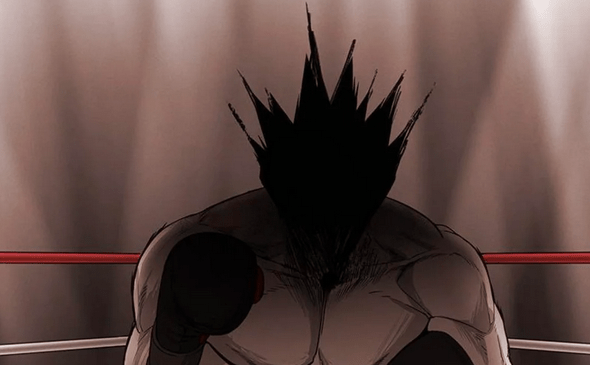
So, what is the point I’m trying to make here? If it wasn’t obvious already, manhwa can be good, and the best manhwa can be on par with the best manga. There are so many other stories that I could talk about or recommend, but I will leave it here. If I had to request anyone reading this, it would definitely be to check out The Boxer. Even if you aren’t a Christian, it is still a great story with lots of action, good laughs, and really unique characters with lots of backstory. I can guarantee that you won’t regret reading it.
My next post will be out eventually; I’m still thinking of what to talk about and when to submit it. I want to try to be purposeful when doing these things, because I think it’s good for me to moderate myself. With that being said, God bless, and I’ll see you later.
 I Wrote A Thing